
Programme Status
Fishing for the future, starting with Silver Wave.
Last Updated: April 2026
Live status of the Tide 2030 programme.
Everything shown here is operating on a working fishing vessel, not in theory.
It shows what has been established under commercial conditions, what is being applied, and what comes next
Silver Wave – Phase 1 Development Complete
Project Brief
Silver Wave established the first operational phase of the Tide 2030 onboard processing programme under live commercial fishing conditions.
The vessel fulfilled its role in proving the core harvesting, tailing, and grading process onboard a working trawler.
The work onboard Silver Wave demonstrated that the system could operate reliably under real fishing conditions while maintaining throughput and reducing unnecessary manual handling.
No further progression is currently planned on this vessel.
Current Status: Phase 1 Complete
Last updated: 14 April 2026
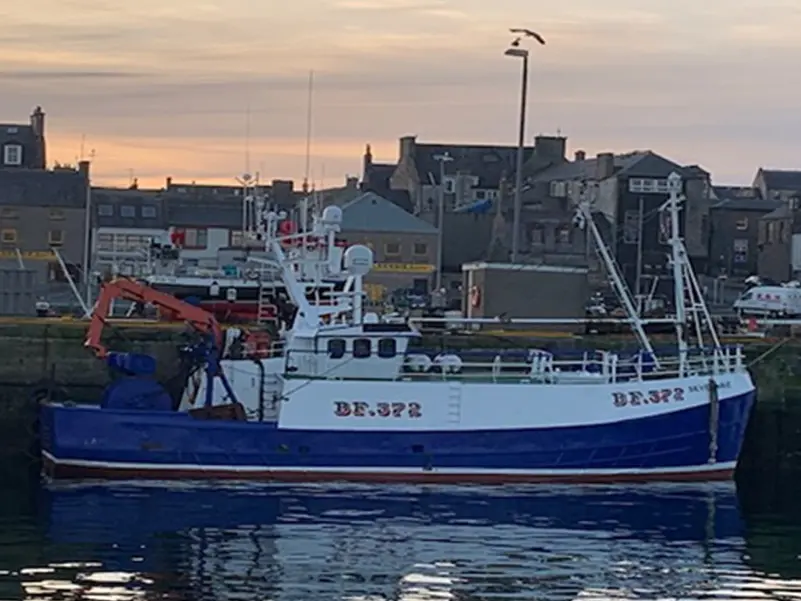
Trial Appraisal - Silver Wave
“The system operated reliably under real working conditions, maintaining throughput while reducing manual handling. It delivers clean, consistent results and has clear potential to improve efficiency and product quality onboard.”
George West
Annadale II - Commercial Deployment
Project Brief
Following completion of Phase 1 onboard Silver Wave, the Tide 2030 programme is now progressing onboard FV Annadale II as part of a major vessel refit and integrated production layout.
Annadale II is not simply testing machinery.
The vessel is being used to understand how onboard handling, grading, conditioning, workflow and production control can operate together under real commercial fishing conditions.
The objective is practical: to establish whether a more controlled onboard production process can improve consistency, handling, workflow and operational confidence at sea.
Rather than operating as separate standalone processes, the work onboard is focused on integrating:
- handling
- product flow
- grading
- conditioning
- packing consistency
- and data visibility
into a more stable operational system onboard the vessel.
This work is taking place during live fishing operations under normal commercial pressure.
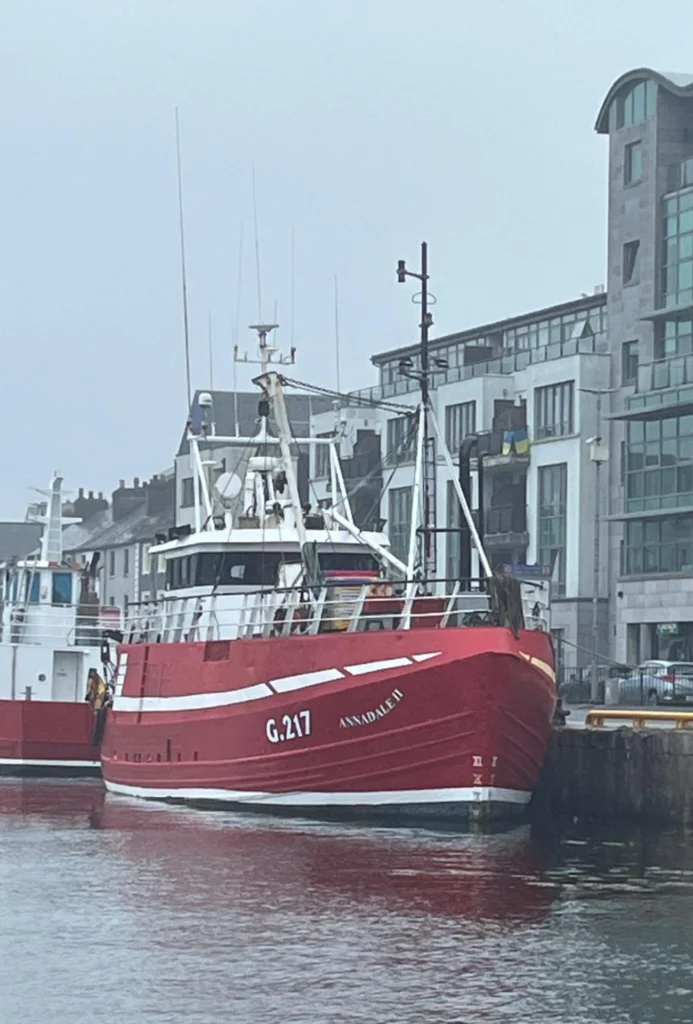
Current Status: Integrated deployment and operational refinement ongoing
Last updated: June 2026
What Is Actually Happening Onboard Annadale II?
The programme is currently working through a number of practical operational areas under live fishing conditions.
These are not theoretical targets or workshop trials.
The work onboard is focused on understanding how practical onboard production can operate under real conditions with real crews, varying catches and operational pressure.
Current Tailing Consistency Evaluation
Live Operational Development Output
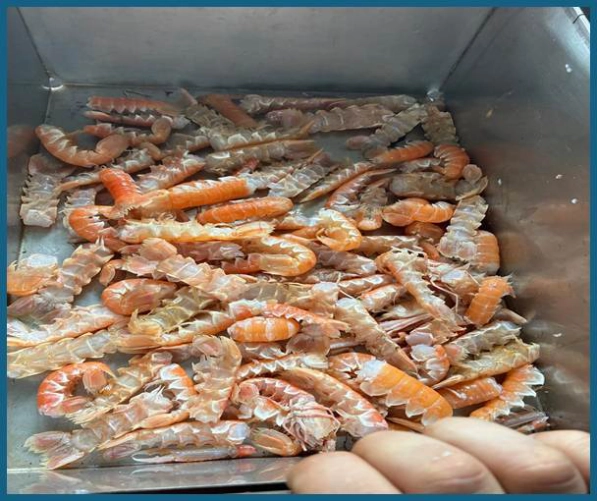
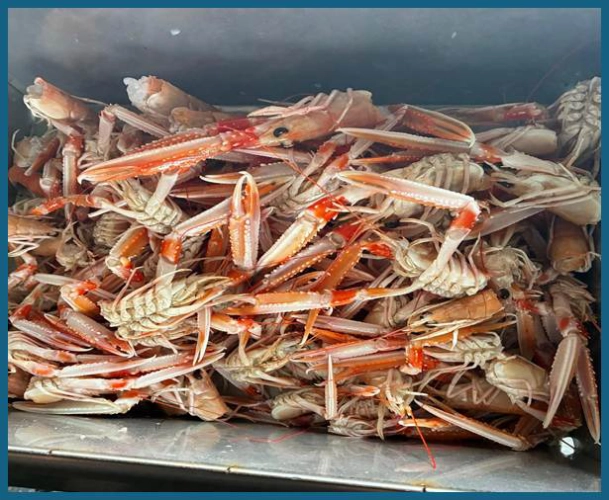
One of the current operational objectives onboard Annadale II is improving tailing consistency under live commercial fishing conditions.
The focus is not simply throughput.
The objective is to establish:
- Cleaner and more consistent tail recovery
- Stable product presentation
- Reduced damage and unnecessary handling
- and reliable operation during continuous onboard processing.
The photographs above show current production output during live operational development onboard the vessel.
This stage of the programme is helping define:
- What acceptable onboard consistency looks like
- How product flow affects final presentation
- and how processing stability can be maintained under varying catch conditions.
As development progresses, the programme will continue refining:
- Handling
- Conditioning
- Grading stability
- and overall production consistency onboard.
The long-term objective is practical: to establish a stable onboard production process capable of supporting repeatable quality and operational confidence across future vessels within the Tide 2030 programme.
Current Operational Focus Areas
- Improving product flow onboard
- Reducing unnecessary product handling
- Improving consistency before grading and packing
- Testing stunning and conditioning processes
- Improving low temperature handling onboard
- Assessing crew workflow and deck practicality
- Developing stable flow between handling, grading and packing
- Stress-testing the system during heavy landings
- Refining grading consistency and counting control
- Improving data capture and traceability
- Understanding staged deployment requirements for future vessels
Current Phase: Improving Product Handling Before Processing
Purpose of this phase
To prepare langoustine to a cleaner, more stable and more consistent condition before grading, packing or further processing takes place.
Current focus
- The vessel is currently refining:
- Product handling flow
- Crew interaction with the system
- Conditioning before grading
- Grading stability
- and operational consistency during live catches.
What success looks like
- Stable throughput
- Consistent grading
- Controlled product flow
- Reduced disruption to crew workflow
- and reliable operation during commercial fishing activity.
What is currently being measured
- Handling time
- Grading consistency
- Temperature stability
- Production flow between stages
- and onboard data reliability.
Expected outcome
A more stable and practical onboard production process capable of progressing toward staged deployment on future vessels within the Tide 2030 programme.
How the Process Works
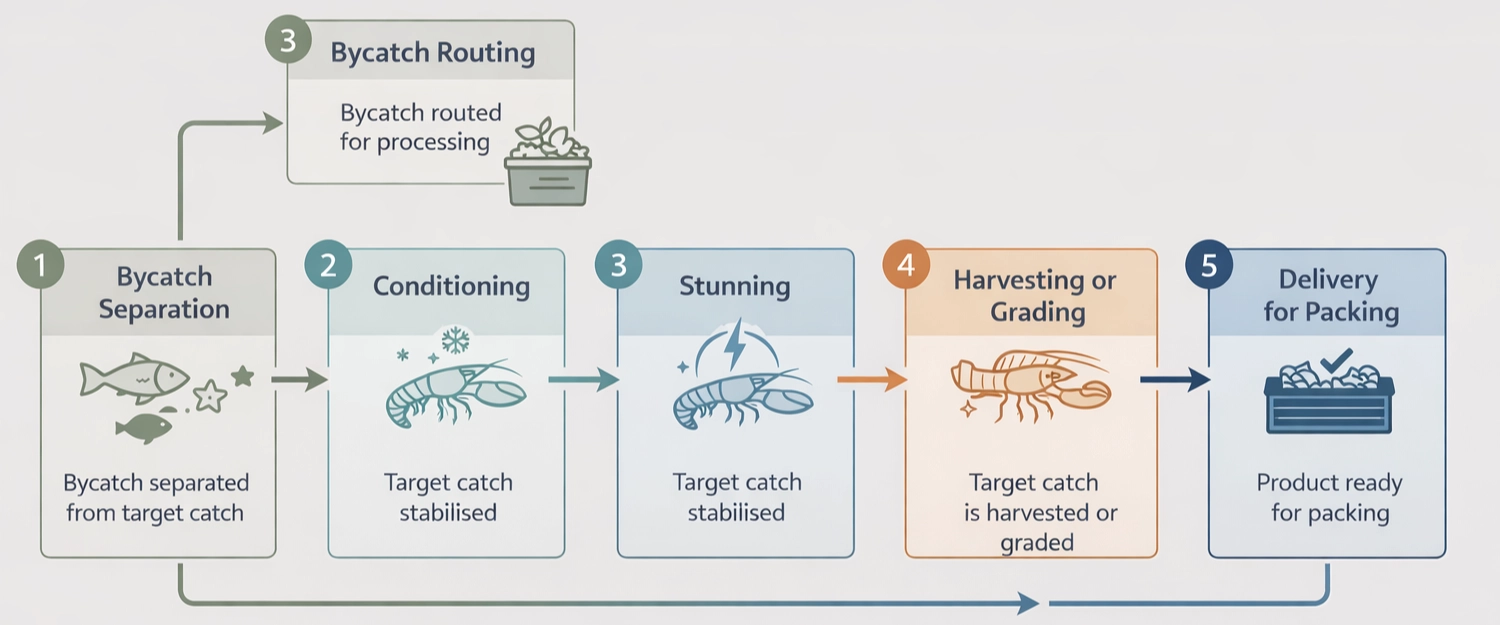
What’s Changing
- Hardware: Upgrade to full marine-grade standards, improving durability, interfaces, and physical design for onboard operation.
- Process: Expansion and refinement to support deeper integration with product handling systems.
- Data: Improved consistency and accuracy through carapace measurement.
- Learning: System adaptation to product variability and changing onboard environmental conditions.
Real Time Vision & Production Control
Development is now progressing beyond basic grading and into wider onboard production control.
- The current work focuses on improving:
- Grading consistency
- Counting accuracy
- Product tracking
- Throughput visibility
- and pack consistency under real operating conditions.
Rather than operating as a standalone feature, the vision system is being integrated into the wider onboard production flow.
- Current focus areas include:
- Real-time carapace measurement
- Lane-by-lane product monitoring
- Improved grading consistency
- More stable packing counts
- Reduced giveaway
- Batch-level production visibility
- and improved traceability support.
The objective remains practical rather than theoretical:
helping vessels achieve tighter control onboard, more consistent outputs, and greater commercial confidence ashore.
Next Steps
- Next milestone: Full system stress test during peak landings
- Update trigger: Completion of five consecutive stable trial runs
- Timing: Next update expected within 30 days
Previous Trial Updates
Phase 1 - Initial Installation
- Early system integration tests
- Prototype grading trials
- Handling flow experiments
Progression Beyond Annadale II
Vision V – Freezer Vessel Integration
While Annadale II is focused on developing a more controlled onboard production process through integrated workflow and handling refinement, Vision V represents the next stage of programme progression.
The focus onboard Vision V is different.
Rather than redesigning the vessel around the process, the work is focused on understanding how the Tide 2030 system can enhance an existing freezer vessel operation.
Current areas under evaluation include:
- Improving processing efficiency onboard
- Refining grading into tighter size bands
- Improving consistency in final pack-out
- Reducing giveaway
- Understanding how workflow integrates into an active freezer operation
- and evaluating where operational value sits within a high-throughput commercial vessel.
This stage is important because it begins testing how the programme can adapt across different vessel types and operational models.
Together, Annadale II and Vision V now represent two different but connected stages of progression within Tide 2030.
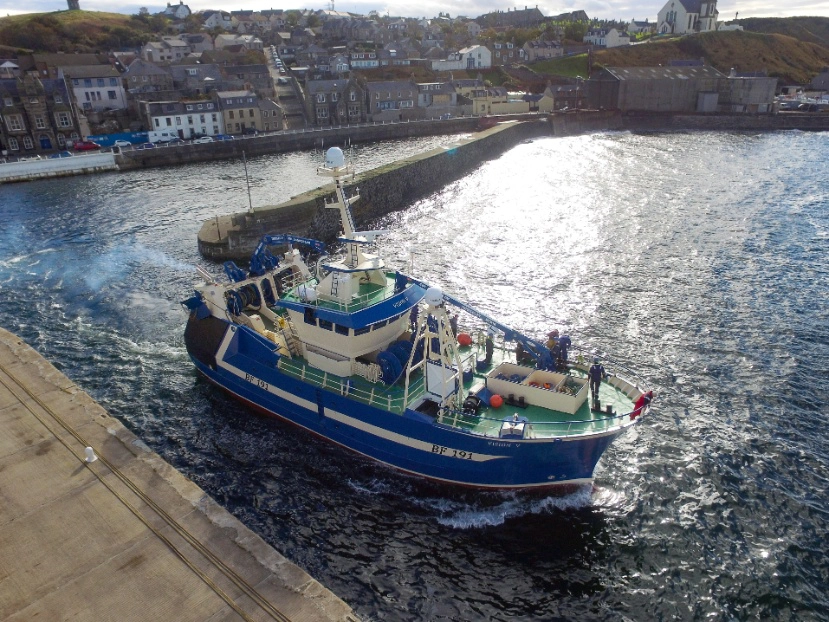
Annadale II
Developing a more controlled and integrated onboard production process through workflow, handling and conditioning refinement.
Vision V
Evaluating how tighter grading, improved consistency and operational control can enhance an established freezer vessel operation.
Development Pathway
Silver Wave
Phase 1 complete — proving core harvesting, tailing, and grading capability under commercial fishing conditions.
Annadale II
Integrated deployment — refining handling, workflow, conditioning, and onboard production consistency.
Vision V
Freezer vessel integration — evaluating how tighter grading, improved consistency and operational control can enhance an established processing operation.
Future vessels
Progressive rollout of modular system configurations suited to different vessel types and operational requirements.
Each stage progresses through live operational learning onboard working fishing vessels.
Stay Close to the Work
Not every vessel is ready to participate immediately.
Many operators may simply want to follow how the programme develops before deciding whether parts of it may suit their own operation.
You can stay informed through:
- Programme Status updates
- Trial Updates & Roadmap
- Tidal Shift | Fisherman Briefing
- and future operational development updates from participating vessels.