
Development Programme
Building the Next Generation of Vessels
Last Updated: April 2026
Today’s Solutions, Tomorrow’s Innovations
This programme is focused on advancing fishing with practical solutions that save labour, boost productivity, and support sustainability.
Each system tackles industry challenges directly, delivering efficient, reliable processes that increase yields and reduce manual labour requirements.
Programme Principle
Tide 2030 systems are developed and proven onboard working fishing vessels under normal commercial fishing conditions.
Each stage progresses only after stable operation has been demonstrated at sea.
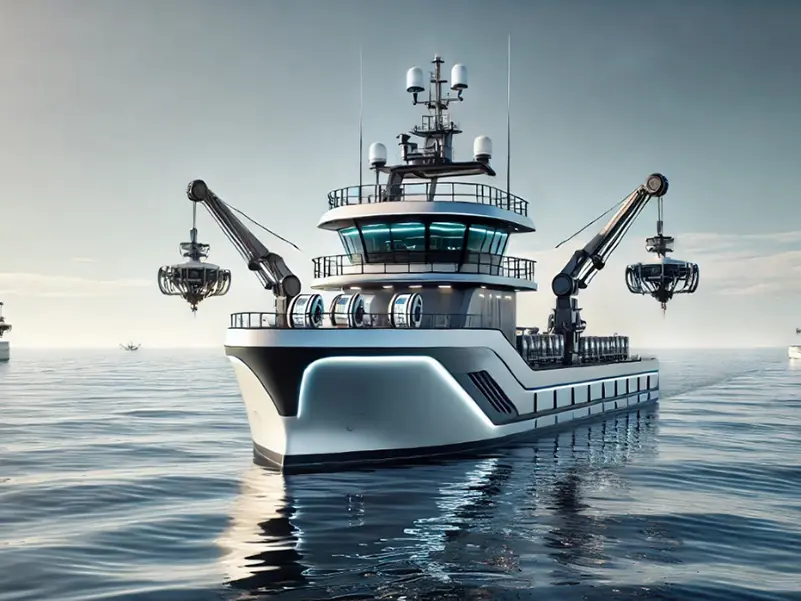
Click above for more info.
Automate Your On-Board Processing
Increase Productivity, Maintain Quality, Meet Standards
Our automated on-board systems reduce manual working —all while delivering a consistent, top-quality product.
With fast, efficient processing, you can meet market demands and stay compliant.
Key Benefits
- Boost Productivity: Reduce manual intervention with automated systems that handle your catch quickly and efficiently, allowing you to focus on higher-value tasks.
- Improve Catch Quality: Automated, gentle processing maintains the freshness and value of your catch, ensuring you deliver premium-quality products.
- Ensure Compliance: Stay ahead of environmental and industry regulations with compliant, responsible reporting integrated into the system.
Automate Your Catching Process
Save Time, Reduce Labour, Maximise Productivity
Our automated approach to the process of trawling up ends traditional practice.
The system minimises downtime, reduces fuel costs, and maintains consistency.
With full automation, you save time, reduce labour demands, and deliver higher-quality yields with less effort.
Key Benefits
- Reduce Labour: Continuous trawling decreases the need for manual labour, allowing crews to focus on higher-value tasks.
- Save Fuel: Optimised automation reduces fuel consumption, lowering operational costs.
- Maximise Productivity: Fewer interruptions and more efficient processes ensure that you can catch more with less downtime.
- Improve Catch Quality: Automated systems handle your catch gently, preserving its market value and ensuring higher-quality yields.
Automate Your Sorting Process
Reduce Bycatch, Save Labour, Protect Marine Ecosystems
Our automated sorting system uses advanced imaging and AI to sort your catch by species and size with precision.
By reducing bycatch and cutting down on manual sorting, you can boost efficiency and contribute to healthier marine ecosystems.
Key Benefits
- Reduce Bycatch: Advanced technology ensures species-specific sorting right at the point of capture, significantly cutting bycatch and waste.
- Save Labour: Automation reduces the time spent on manual sorting, lowering labour demands and allowing your crew to focus on higher-priority tasks.
- Protect Marine Ecosystems: Accurate sorting preserves biodiversity, ensuring compliance with environmental standards while maintaining efficient operations.
Safeguarding Skills & Livelihoods
Behind every advance in Tide 2030 is a simple goal: to protect the people whose skills sustain wild-catch fishing. Automation here does not replace jobs — it secures them. By reducing fatigue and injury, improving welfare, and keeping vessels compliant with evolving standards, we ensure crews can fish safely, profitably, and for longer.
- Protecting Crew Welfare – reducing strain and risk through automation.
- Retaining Skilled People – upskilling crews to operate advanced onboard systems.
- Keeping Vessels Viable – compliance and product quality sustain market access.
- Sustaining Coastal Economies – higher-value landings support shore employment.

“Real sustainability means protecting people as well as stock — every stage of Tide 2030 is designed around welfare and continuity of employment.”
Tom Rutherford
Investing in the Future of Fishing
Working Together to transform the future of fishing our strategic partners are purposefully chosen to align with our values and goals. Through these partnerships, Tide 2030 is advancing sustainable, automated solutions for the fishing industry.

SeaQuest Systems
A leading company specialising in fish pumps and hydraulic systems for fishing and offshore vessels. Their products are highly regarded for their superior design, construction, and performance, meeting the industry’s highest standards. With ISO approval and adherence to DNV and Lloyds classifications, the equipment is of exceptional quality and reliability.

Cortha
Known for their professional sales and service, they have become the de facto supplier of AI imaging technology to many engineering companies who rely on their skills and expertise to provide the right product, not just in terms of its suitability for the application but also for reliability and continuity of supply.

Polar Systems
A respected innovator, developer, and manufacturer of sea food processing equipment, supplying to a global market. Polar Systems continues to build on their reputation for developing creative solutions to process problems.

Aigean
Aigean delivers project management and financial services to the fishing industry, combining technology innovation with financial support. We aim to drive independent progress on key projects while fostering collaboration and trust. Our initial focus is on launching new processing technologies, with plans to expand and address broader efficiency challenges within the industry.
See the Progress in Action
Explore how Tide 2030’s developments are already shaping the fleet. Visit the Trial Updates & Roadmap to see vessel milestones, live trials, and future phases.